
No products in the cart.
Outdoor Adventure
David Roche Is Betting Big on Carbs, Grit, and Love

04
Apr
Apr
Roche’s athletic career began with a sport diametrically opposed to running: football. Indeed, at a 2018 induction ceremony to the Queen Anne’s County High School Sports Hall of Fame, Roche joked, “I kind of look like an equipment manager now.” A running back and defensive back on Maryland’s eastern shore, Roche journeyed to New York City to play at Columbia University. He left the sport behind after his freshman year and started to run.
In his since-archived blog about running, Roche wrote about New York City, where life felt constricting, even choking, the kind of life that makes someone ask the question why nearly every day. Trail running soon became the place to be most fully himself, and he escaped the constraints of the city for the sanctuary of trees. He placed second at the Wissahickon Trail Classic in 2009, and it was all about the trails from there. Of that race, Roche told me he remembers, for the first time, thinking it was fun. “Whereas every other harder run I’d ever done on roads, I probably wasn’t in shape enough to enjoy it. I’d just be like, ‘This is terrible,’ and then I’d get stomach pains after,” he said. “When I got on trails, something about my physiology embraced it and liked it.”
After New York, the hills and rocks and roots of North Carolina, where he went to study law after graduating from Columbia University, soon became his best friends. And it was there, in North Carolina, that he met Megan, his future wife and biggest supporter. He proposed to her with a Ring Pop.
“Sports are the coolest places to try out different multitudes,” Roche said.
In those early years, Roche became someone who could be simultaneously ambitious and joyful. He got good at running and pretty good at being himself. His blog posts from those early years of trail running reveal a side of David Roche not all too different from the David Roche of today. He is sharp and witty and playful, his race reports filled with meandering asides about anything from Achilles tendons to digestive tracts to environmental law. There’s a sense of burgeoning joy at the heart of someone who is reveling in the fact of being good, and maybe even really good, at something. And Roche was good. He won the United States Track & Field Association’s (USATF) 10K Trail Championships in 2012, held at the Continental Divide Trail Race, along with numerous other trail races and sub-ultras. In 2014, he was named USATF’s trail runner of the year. All the while, he was writing witticisms and meditations and race reports. He was winning and having fun.
“I’d much rather be the virtue of play and joy—and the self-acceptance that comes with that—because at the end of the day, the chance that I fail at these big goals that I’m saying out loud is probably 99.5 percent.”
This kind of multitudinous aspect of Roche’s personality is perhaps part of the reason why he has become a polarizing figure in the niche world of ultrarunning. There are Reddit threads and Letsrun forums populated with users who criticize his training methods, his claims, his coaching style, and more. There are also many devoted fans. But it does seem that many people take issue with his attitude—a relentlessly upbeat positivity that can, at times, be so relentless that one can’t help but question if it is authentic.
When viewed from a distance, Roche’s persona seems to be this entirely shining, positive, polished thing, but up close, Roche is quick to admit his propensity toward wrongness and failure. He told me how comfortable he has become with the idea of failure and how often he has had the thought that he’s not good enough. “Throughout my journey,” he said, “There’s been a constant narrative in my own head that, ‘You’re not the guy.’”
Now 36 years old, over a decade after those early trail races, Roche has decided that he can be not just the guy but also someone who models what it looks like to reach for the stars while knowing full well how far away those stars are. “I’m just trying to use my short time with this window to hopefully model for people that the meek humility I think a lot of people want to see in their athletes is just fear masquerading as virtue,” he told me. “And I’d much rather be the virtue of play and joy—and the self-acceptance that comes with that—because at the end of the day, the chance that I fail at these big goals that I’m saying out loud is probably 99.5 percent.”
Roche’s belief in himself and in others comes with constant reminders. As Roche talked to me, I noticed a wall-hanging above his dining room table that read “You Are Enough.” Scotch-taped to his bathroom mirror is a handwritten sign that reads, simply, “BELIEVE.” On a run along the Boulder Reservoir, I listened to him offer his trademark encouragement—“You’re awesome”—to a handful of runners, and even someone who seemed to be repairing a telephone pole.
These moments of encouragement are reinforced and elevated by Megan. “I am here to demonstrate what love mixed with being a tough motherfucker looks like,” said Roche. “And, in Megan, I see the toughest person in the world.” Their love is public and loud; it is visible and enormous. While talking with David post-run, I watched Megan walk in and immediately pepper David with questions about his workout. They talked as if I wasn’t in the room. It was like watching people speak with exclamation marks hovering above their heads. Her excitement for his run. His excitement for the workout she was about to do. Excitement is a kind of labor, and what we work on is also what we love. Their love exudes the intentionality of a training plan. It is a daily process.
Their children are part of that love, too. Roche’s second son, Ollie, is named after the poet Mary Oliver. “Tell me,” Mary Oliver writes, “what is it you plan to do with your one wild and precious life?” It’s a question that is most likely tattooed on the inside of David Roche’s skull. And it’s a question, too, that holds life’s fragility at its heart, which Roche now knows a lot about.
There’s another, lesser-known Oliver poem, “The Journey,” which perhaps contains Roche’s answer to Oliver’s own question about life. In it, Oliver writes:
But little by little,
as you left their voices behind,
the stars began to burn
through the sheets of clouds,
and there was a new voice
which you slowly
recognized as your own,
that kept you company
as you strode deeper and deeper
into the world,
determined to do
the only thing you could do—
determined to save
the only life you could save.
When David Roche woke up from that headlong collision into a fence, he became “determined to save / the only life” he could save. And saving meant reclaiming the power of his story, which also meant reclaiming the all-ness of his story, how it contains both joy and ambition, success and failure. That accident seemed to be the catalyst for the current journey of his life, this journey of striding more deeply into the world and his vision of his place in it.
In speaking and running with Roche, I couldn’t help but notice that he is someone who is fully starting to embrace who he is, to embrace that new voice he recognizes as his own, which is a voice of complicated, multitudinous paradox. He throws out loving encouragement at the same time as he fosters a deep, competitive sense of ambition. He happily and publicly declares a wild goal at the same time as he is the first to admit the farfetched nature of it. He is vulnerable at the same time as he is, in some ways, brazen and full of it. On his living room carpet, I watched him create, with his own body, a protective cocoon for his youngest child while allowing his oldest child to roll a monster truck off his back and into the air.
Some of us harbor a devil on our shoulder or a brutally negative inner voice that tells us we are not enough. But for Roche, that negativity has been transformed. “There’s always a wink in the background of everything that happens,” he told me. He was talking about Kurt Vonnegut, one of his favorite authors, someone who believed in kindness and darkness at once. “It is a tragedy,” Vonnegut wrote, “That human beings can get so much energy and enthusiasm from hate.” Vonnegut begged readers to choose kindness, to keep winking through the darkness.
This wink is the acknowledgment that there is a bit of mischief and mystery in every story, like a child in the backseat of a car, asking why or are we there yet or did you see that, over and over again. That child, the one calling shots in the backyard ballgame, dancing in their underwear, wondering out loud, is a child that lives in all of us until we stop listening to them, or stop hearing them.
Last year, David Roche started listening to that child again. And he hasn’t stopped. “Fuck it,” that child said, “go for it.” And so he did. Choosing life after near-death. Choosing ambition after what he told me was a kind of “false humility.” Choosing confidence after all his insecurity. In her canonical poem, “Wild Geese,” Mary Oliver writes, “You do not have to be good.” Roche would say something similar. That you don’t have to be good. But that it’s really fun to try. And that it’s alright, and maybe even a little entertaining, if you fail.
When he was talking to me about entropy and impermanence and death, Roche told me, “The only thing that can help other people out is to inject energy into the system. And so, you know, in the face of the darkness, you’re just trying to bring as much light as possible even though I’m feeling the darkness in the same way that I think most people are, at least if they think about it deeply enough. And so for me, love is just being, like, we get one shot at life.”
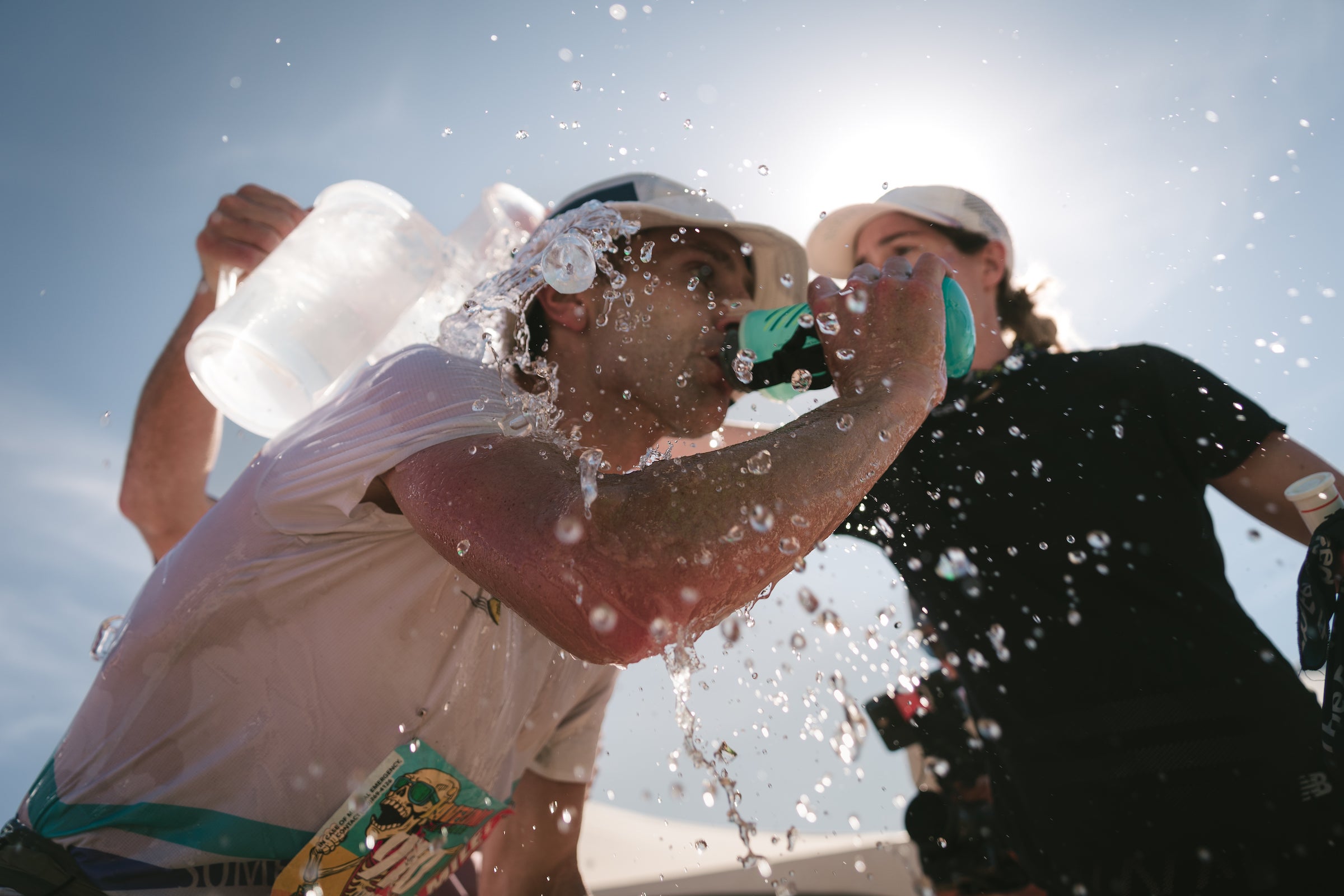
Darkness and light. Love and sorrow. These paradoxes live in the heart of each of us and they live, too, in the heart of David Roche. They live in the landscape of our world, in mountains and valleys, in the snow at the top of Western States’ highest climb, and in the rugged, desert-dirt heat at the race’s lowest point. David Roche is a topographical map of a person. Peaks and valleys. All at once. To encounter him, then, is to encounter someone who so fully embraces a mindset of both humility (“I don’t know”) and ambition (“but fuck it, I’ll try”) that one cannot help but be drawn in. He is the man in the arena, and whether we like it or not, we have access to it, to the Strava files, the uphill treadmill runs, the hill sprints, the intervals, and the encouragement along the way. I don’t know what will happen at Western States this June in Auburn, California. David Roche is the first person who will tell you he might win. He is also the first person to tell you he might not. Somehow, he is both of those people at once.
Source link
