
No products in the cart.
Outdoor Adventure
I Tried Extreme Sauna-ing to Outsmart Seasonal Depression

16
Dec
Dec
Published December 16, 2025 03:42AM
With a bundle of birch leaves as my pillow, I’m in my swimsuit, lying face down on a makeshift massage table in a 180-degree sauna tent. I hear the hiss of water on hot rocks before I feel boiling droplets hit my back. The dripping turns to brushing—someone’s gently sweeping me with oak leaves now—and then suddenly, they start whacking me. Back, butt, legs—nothing’s spared. My first thought: Is this supposed to be relaxing? My second: Because it feels kinda good.
The person wielding the leaves is named Dustin. He’s performing what’s called whisking, an ancient Slavic and Scandinavian sauna ritual that involves soaking bundles of birch, oak, and eucalyptus leaves in warm water until they’re soft and fragrant. Then, they’re used to brush, pat, and swat the body to stimulate circulation, cleanse the skin, and release the natural oils of the leaves for aromatherapy. In Russia, this practice is called Platza. In Finland, it’s Vihtominen.
My skin tingles. The steam grows hotter. After about ten minutes of this, Dustin tells me to turn onto my back and covers my face and head with the birch leaves that served as my pillow. He then goes through the ritual again: sweeping and slapping. At the end, when my skin is as red and raw as a ripe tomato, he pours cool water from a watering can over my body.
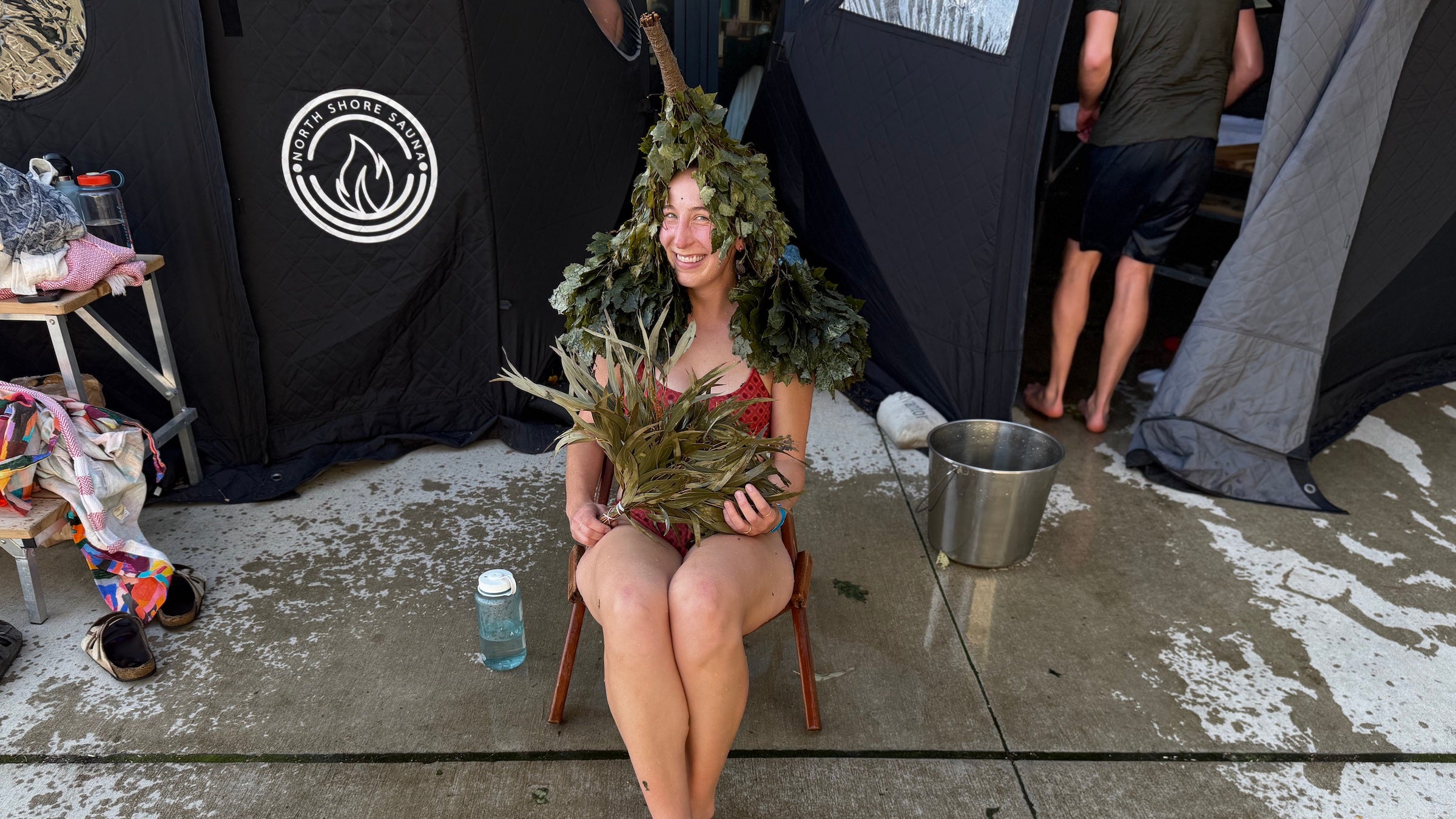
But the experience is not quite over. Dustin guides me to a wooden folding chair outside the heated tent. He rustles the wet leaves at me—I brace myself in the cold—before he drapes the branch bundles onto my head and shoulders like a crown. My treatment is over. I feel a little silly sitting there in the open courtyard, but then again, it’s not so weird, as I’m among 847 attendees, ages 10 to 68, of the first-ever Seattle Sauna Festival. We’re all there to immerse ourselves in sauna culture together, which, I have discovered, includes getting flogged with wet foliage.
Held over the weekend of daylight savings, I drove three hours from my home in Portland, Oregon, hoping that perhaps the festival could prevent, or at least prolong, my annual spiral into seasonal depression during the bleakest time of year in the Pacific Northwest.
With six months of dreary weather ahead, residents here adopt all kinds of coping tactics to survive the constant cloud cover and steady drizzle that often lasts through April. As motivation to crawl out of our hidey holes at home and be social, some of us join book clubs, some host game nights or dinner parties, and some take up knitting. Others sauna.
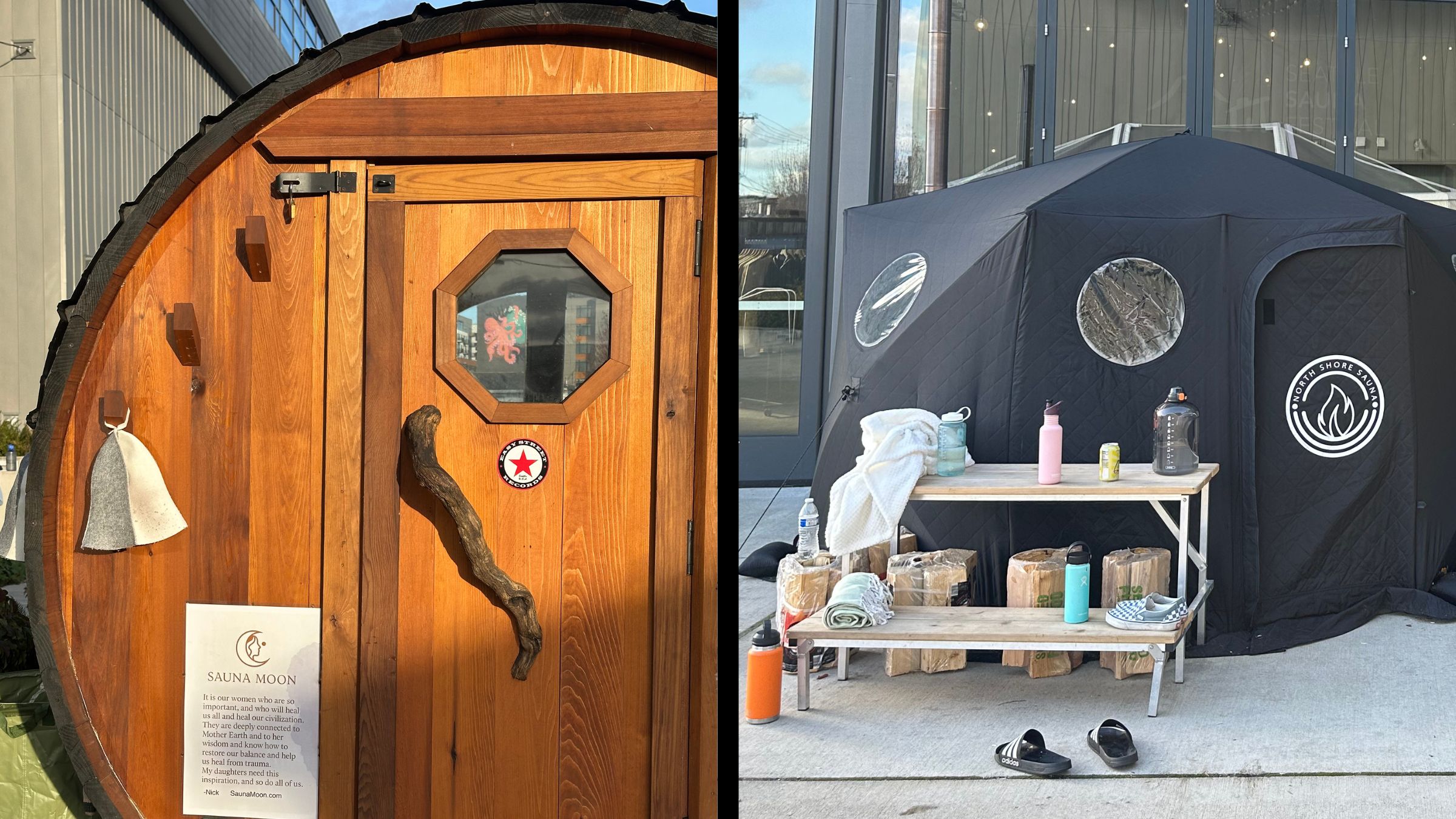
When I arrive at the festival, I follow a bare-chested man in swim trunks, flip-flops, and a robe to the Nordic Heritage Museum. In the parking lot are seven different types of saunas. A barrel sauna on wheels. A converted vintage camping trailer. A hut that people call “the greenhouse” because it looks like one. Two sauna tents. Among the saunas are showers and tubs filled with ice water. Steam clouds around the head of someone who has just dunked their full body.
Inside and outside the museum, people walk around in robes, towels, and swimsuits. Some wear funny-looking tulip-shaped felt hats that I later learn protect your head from intense heat and regulate your body temperature so you can stay inside the sauna longer. Eventually, I will get one for myself.
I grab my wristband, change into my bikini in a privacy tent, and carry my water bottle and towel to the sauna village. I make a note of the community guidelines: No PDA. No unwelcome or uninvited physical contact. No controversial or offensive topics. No prolonged eye contact.
The first sauna I choose is the barrel. Its portal-like window is completely fogged up so I can’t tell that it’s already at capacity by the time I open the door. But I’m committed now, so I squeeze into a spot across from another woman who appears to be solo. We trade a few brief glances—no prolonged eye contact!—before one of us introduces ourselves. She’s here with two friends, both of whom she’s since lost in one of the other saunas. The three of them partied the night before.
“Sorry if I reek of alcohol,” she says. But I can only smell the cedar of the barrel and dried eucalyptus propped up near the stove.
The old claim that you can “sweat out toxins” has largely been debunked. Still, there’s clinical evidence that heat therapy is good for our bodies. A 2021 report found that repeated sauna use can optimize a person’s stress response by building heat shock proteins, protect against cardiovascular and neurodegenerative disease, and generally extend one’s lifespan. And a study from 2022 shows that using the sauna 15 minutes after a workout, three times a week, improves cholesterol levels, cardiorespiratory fitness, and blood pressure. Doctors in Scandinavian countries regularly prescribe sauna sessions to patients.
Next, in the vintage trailer sauna, I meet a thirtysomething guy from the UK who works in finance. He likes my tattoo so I give him the name of the artist. His friend, who moved to Seattle less than a year ago, asks me how I got into sauna-ing, and I think of 2020. A month before the pandemic, I was on a trip to Canada, where we stayed in a lodge next to a frozen lake. A hole had been cut out of the inches-thick ice and a ladder led underwater. I didn’t even consider plunging until I learned that there was a sauna at the lodge to warm up in, before and after.
“What about you?” I ask them.
“He bought my ticket,” the friend replies.
The Brit and I run into each other again in what is rumored to be the hottest sauna of them all, set to 200 degrees, when a group of seven or eight women ranging in ages, from their early forties well into their seventies, enters the room. Dewy and glowing with sweat, they are like goddesses. Mesmerized—but not staring!—I ask if they’re all together.
“We’re a women’s rowing team from San Francisco,” one of them says.
The Brit gets up to leave. “Too much feminine energy, huh?” jokes another lady once the door shuts.
They’re in town for a regatta at Seattle’s Lake Union and, in looking for things to do during their visit, they found the sauna festival. They answer my questions about rowing and practicing in the San Francisco Bay, and we chat until I can’t stand the heat any longer.
“Come see us at the Marin Rowing Club,” one woman says before I go. “We’ll take you out.”
Most people I meet are there with friends. Meanwhile, I’m on my own because my husband stayed back to watch our dog. He’ll get his sauna time soon, though. One of the perks of the climbing gym we belong to is the small sauna in both the men’s and women’s locker rooms, a refuge we cling to when the gray months stretch on. In the dead of winter, when our bones are chilled all the way to the marrow, and we’ve almost forgotten what it feels like to be warm, it is grounding to step into a cedar-walled room heated to 180 degrees and sweat alongside our climbing buddies.
That’s part of why, since moving to Portland in 2022, we’ve also made a seasonal ritual of splurging on a visit to a local wellness club every November. For two hours, we rotate between the tepid pool, hot tub, cold plunge, dry sauna, and steam room, and then we grab coffee after.
Without him at the festival, though, I don’t have anyone to talk to except the strangers around me. Going into it, I worried I’d either get lonely or spend the day awkwardly navigating conversations I didn’t come for. But it turns out that it’s easier to make conversation with people while half naked and sweating profusely than fully clothed with a drink in hand, even in a city with a reputation for keeping newcomers at arm’s length—a social phenomenon known as the “Seattle Freeze.”
“It’s hard to meet people here,” festival founder Ryan Davis tells me. “I think that sauna really brings people together. You kind of literally strip away all of your baggage—or your clothes.”
Davis came up with the idea for a sauna gathering after attending the Great Northern Festival in Minneapolis, Minnesota, where a “sauna village” offers 20 distinct saunas and experiences. In November 2024, he met his co-founder, Ana Hernandez, owner of PNW Mobile Spa, and they spent the last year planning the event. As of now, only a few other cities in the U.S. host sauna festivals: the Michigan Sauna Fest in Traverse City, the Great Duluth Sweat Together in Minnesota, and the Bathe-ing DC wellness festival in Washington, D.C. Next up: Portland is getting ready to host the Willamette Sauna Festivaali in February 2026.
The main draw to any sauna festival is the saunas rolled in by local businesses, of course. But the Seattle event is also part trade show and part educational opportunity. Festival attendees get 50 percent off admission to the Nordic Heritage Museum for the weekend. Before changing into my swimsuit, I head upstairs to wander through the exhibitions about Denmark, Norway, Finland, Sweden, and Iceland. (I learn about fishing, weaving, and design, though I find zero materials about sauna culture, but Davis and Hernandez later inform me that the museum has its very own Estonia-built sauna, one of the oldest working saunas in North America.)
Downstairs, vendors line the museum’s Great Hall, including sauna builders and wellness and advocacy groups. Panels about contrast therapy and breathwork give attendees a chance to dive deeper, exploring techniques and health benefits around the ritual. And an exclusive episode of The Upper Bench podcast, about the world of Finnish sauna, plays during stage breaks.
The event also gives business owners a chance to meet one another in a genuinely collaborative way and start building a loose sauna network. For many of them, it is the first time they’ve swapped stories about navigating permits, sourcing wood, and growing the community. “My customers will say, ‘New sauna…new competition,’” Hernandez says. “I remind them, you guys, this is not a competition. My ten-person sauna cannot serve all of the Pacific Northwest.”
For her, the point isn’t guarding turf; it’s growing a sauna scene. And for all in attendance, the more saunas there are, the more opportunities to sweat together.
On Sunday, I wake up between the white sheets of Hotel Ändra, a Scandinavian boutique hotel downtown that offered to host me during the sauna festival, and run four miles along the waterfront, pushing my pace faster, knowing that I’m about to melt my muscles again. I convinced Hernandez and Davis to let me attend for another day—for “research”—and I’m feeling more brave now that I know my way around the venue.
I get to the festival a little after noon to catch a German sauna ritual called aufguss, which translates to “infusion.” Someone in the role of “sauna master” adds water mixed with essential oils to create steam, then dramatically whips the heat around the room with a towel toward saunagoers without smacking them in the face. Like yoga teachers, these sauna masters are certified through courses that teach them the specific towel-swinging techniques. There’s even an aufguss world championship, and the first stateside event happened in New York in September 2025.
Four people are already in the sauna when I get inside. The only available spot is nearest the stove. Having experienced this technique earlier this year on a trip to the Nordik Spa in Quebec, the largest spa in North America, I prepare myself mentally to sweat—a lot.
Our guide is a woman named Diana wearing a white skort and a crop top. She plops a lavender-scented snowball onto the hot rocks, cranks the song Wonderwall by Oasis, and starts dancing, singing, and flicking a towel at us with the enthusiasm of a 1990s aerobics instructor.
The heat hits my face as she twirls, and then suddenly sweat is pouring down my spine and sternum. Four minutes and 19 seconds have never felt so long. We’re allowed to dismiss ourselves if it gets too hot, but I’m staying strong. If Diana can dance and sweat, I can sit still and sweat—a competition I realize is unfair, given that she probably does this with regularity. I put my hands on my knees and hang my sweaty head. The others in the room pant and breathe heavily, too. Have You Ever Seen the Rain by Creedence Clearwater Revival plays next to the scent of lemon grass, and Dog Days Are Over plays after that to the scent of peppermint.
To get through it, I tell myself that all this sweating is good for me. That afterwards, the tension I forever carry in my neck and upper back will melt from the heat. That, by sweating so much, I’m stimulating my cardiovascular and immune systems.
“You’re doing so well, we’re almost done,” Diana says in between singing along.
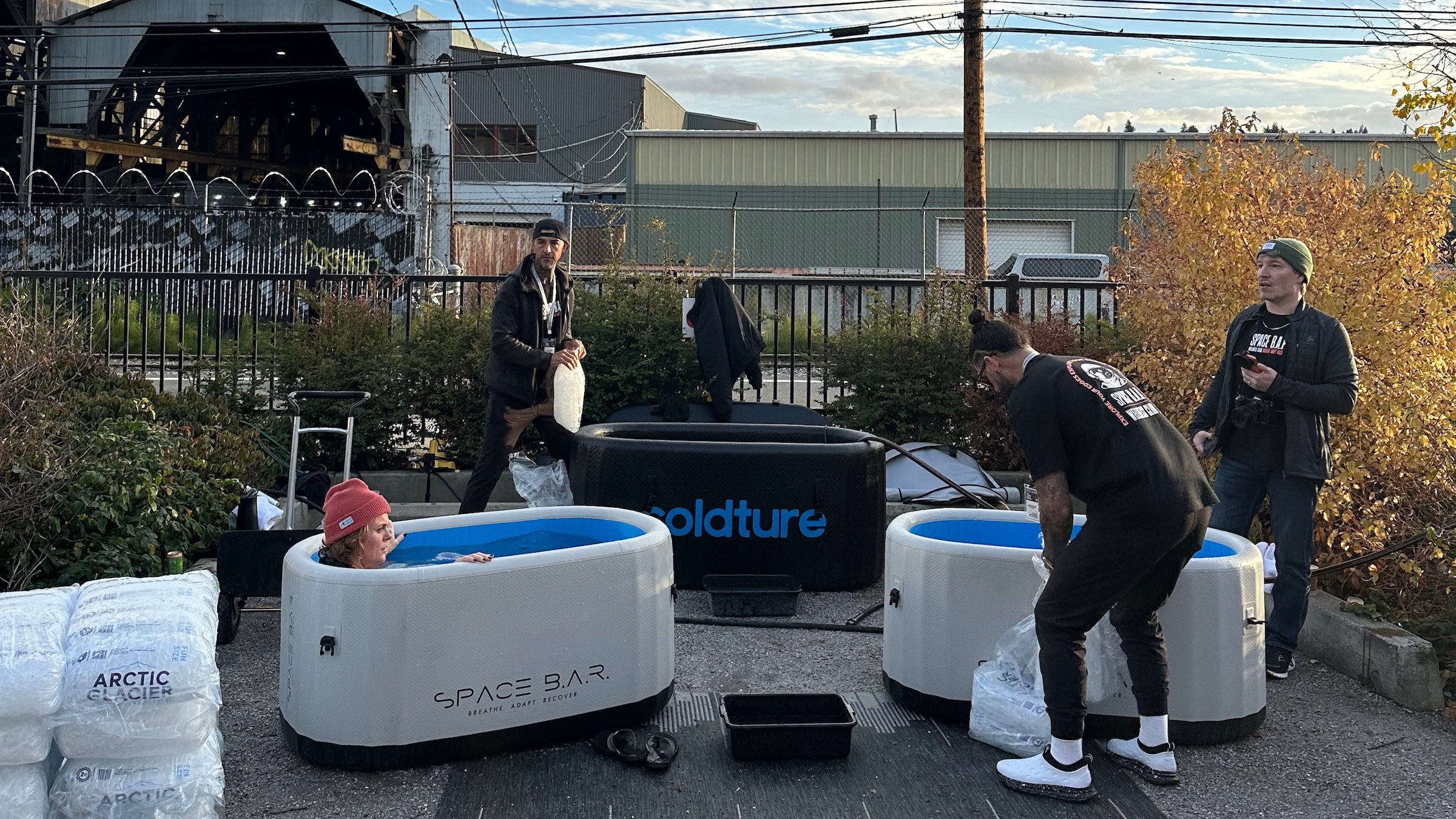
Twelve minutes later, once my skin is glistening like a rotisserie chicken, I emerge into the cold air, pink as shrimp and dehydrated. The only thing that I can think to do is submerge myself up to my shoulders in one of those buckets of ice water. I stay in the 50-degree water for 7 minutes, impressing myself and even the breathwork coach facilitating the cold plunge area.
“Most people stay in for 30 seconds to 2 minutes,” he tells me.
What one person calls wellness, another considers torture. And I’m walking a fine line.
“Look how healthy these people are!” I overhear Davis say at the event.
Because I’m feeling emboldened, this is the moment I decide it’s a wise idea to sign up for the whisking experience next. By the time I get out of the sauna tent and shed the leaves ensconcing my head, it’s late afternoon. For one final time, I dunk in the cold plunge, this time with a woman who I met in one of the saunas earlier that day. This is her first time cold plunging. We sit in the tub together for three minutes, and we high-five when we’re done. Again, I think: Is this supposed to be relaxing? Because it feels kinda good.
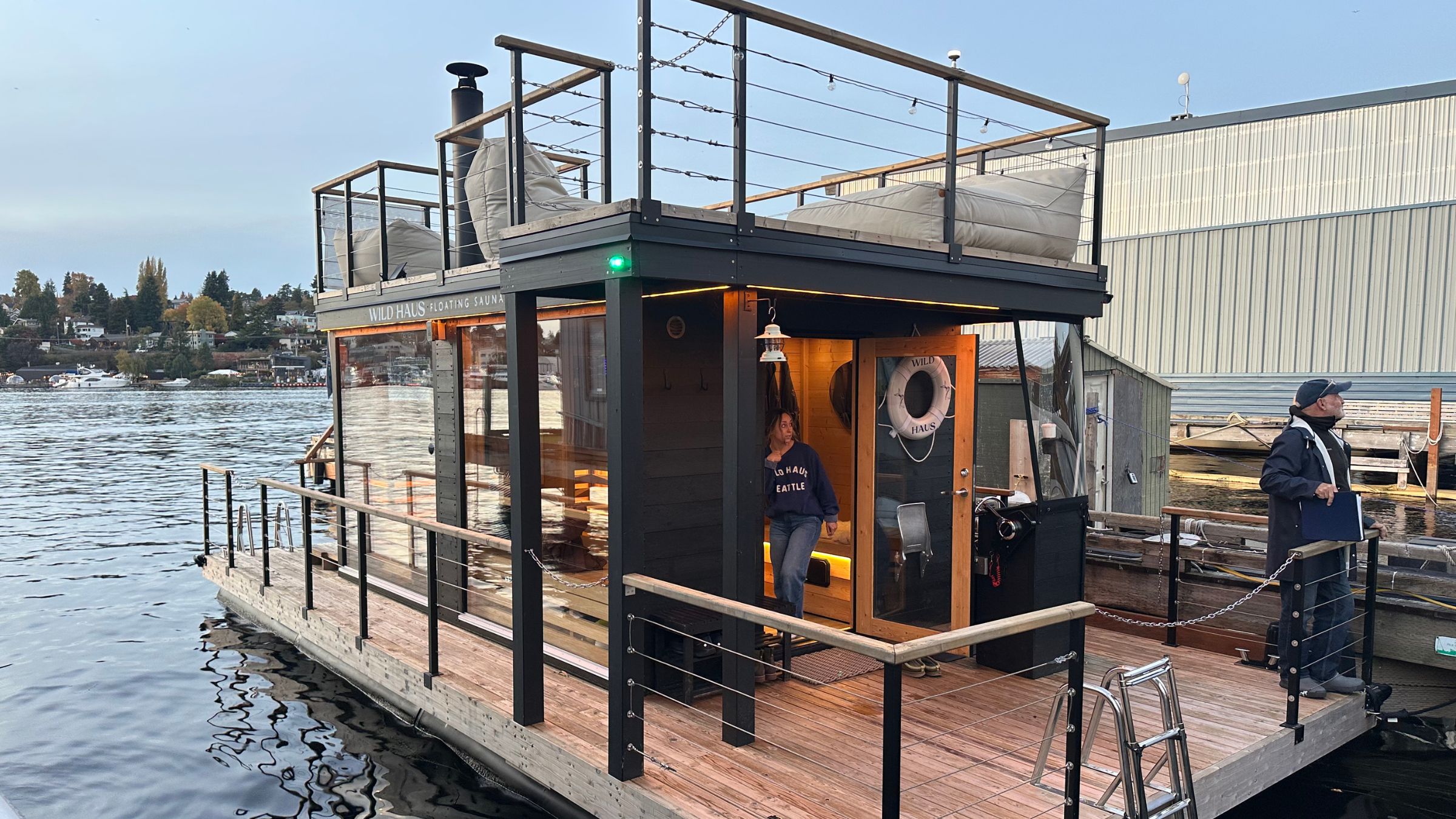
Once I leave the Seattle Sauna Festival, I still have one more sauna left to experience. I’m booked for a 90-minute sunset voyage with Wild Haus, a floating sauna on Seattle’s Lake Union. Less than a year ago, a group of eight friends, including one Swede, transformed a 30-foot houseboat into a glass-walled, wood-fired sauna with a rooftop deck. They charter private and communal floats, in which a captain drives you around the lake while you drip sweat and dive into the lake that’s a chilling 45 degrees on average.
Once again, I’m on my own and, this time, the fourth wheel to a group of three friends who also happened to party over the weekend. They’re sore from dancing, while I’m blissed out from my extended spa weekend. Our captain, Leroy, leaves the harbor and speeds away from other boats. I remember that this is where the women’s rowing team had their regatta. I wonder how they did.
As the sun fades, we drive by massive yachts and dimly-lit houseboats that remind me of the movie Sleepless in Seattle. When Leroy cuts the motor, it’s fully dark out. He tells us we can jump off the boat’s upper deck if we want. I’m considering jumping from the lower level instead, but one of the friends is quite convincing. “When else will you get to do this again?” she says.
I climb the staircase with them. Facing the glittering Seattle Space Needle, I plunge into the black mirrored water below me, quickly rise to the surface, crawl out, and warm up again in the sauna. We do this three more times before our time is up and we head back to the dock.
I think I’m going to be just fine this winter.
