
No products in the cart.
Outdoor Adventure
Puma’s Crazy-Looking Prototypes: Joke or Genius?

25
Oct
Oct
Published October 25, 2025 04:00AM
When Puma revealed five radical prototypes at the 2025 World Championships in Tokyo, the running shoe world laughed. With their jagged midsoles and sky-high stacks, the prototypes looked more like science projects gone wrong than functional footwear. But behind the spectacle was a deliberate strategy built on a simple idea: innovation flourishes when out-of-the-box thinking is applied to constraints.
Almost a decade earlier, Nike’s carbon-plated Vaporfly sparked a revolution that redefined what running shoes could do. Nike athletes wearing the Vaporfly dominated races around the world. In an effort to put guardrails on what athletes could wear during competition, World Athletics imposed limits to contain the chaos, capping stack heights, restricting plates, and forcing innovation to evolve within strict rules.
With the rules established and boundaries clear, it was up to designers and engineers to innovate within those limits. No company has embraced that challenge quite like Puma. While Nike, Asics, and Adidas dominate the spotlight, Puma’s recent innovations reveal that they are very much on the cutting edge of, if not leading, shoe design.
Boldly Blowing Past Boundaries
Consider the launch of Puma’s Fast-R Nitro Elite 2 in early 2024, the second iteration of their flagship raceday shoe. Puma pioneered the use of Aliphatic TPU (A-TPU), a new midsole foam that had never been applied in this context. At the time, PEBA was the gold standard for super shoe foams, but A-TPU surpassed it in both energy return and resilience. It didn’t take long for other shoe brands to follow suit. Today, A-TPU is on a trajectory to become the new de facto super foam, already appearing in models from Asics, Speedland, and Tracksmith.
Then, around the 2025 Boston Marathon, Puma unveiled the Fast-R NITRO Elite 3, along with Puma-funded lab tests that showed up to a 3.6 % improvement in running economy compared with leading super shoes like the Nike Alphafly 3 and Adidas Adios Pro Evo. Since then, Puma has tested the shoe with over 100 athletes across a range of abilities, and reported that every participant showed improved running economy over competitor models. While I haven’t done lab measurements on running economy, I have done a back-to-back test against 14 other super shoes. Running a set loop with a similar effort in each shoe, I found that the Puma delivered one of the fastest reps.
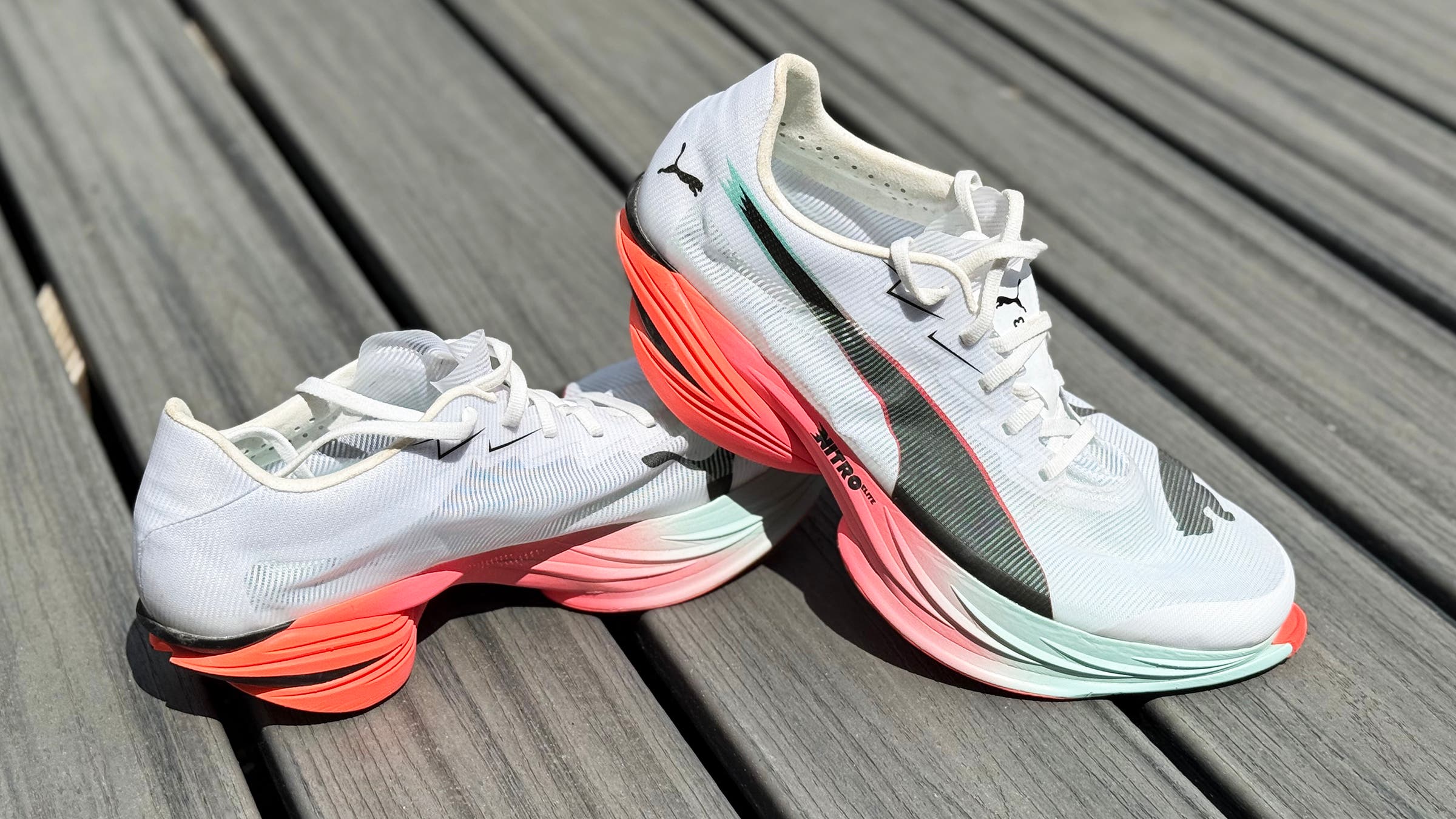
Puma Fast-R Nitro Elite 3
Despite these successes, Puma’s innovation has not always been taken seriously, often labeled a gimmick rather than true innovation. On the surface, it’s easy to see why. Puma has never shied away from pushing visual boundaries, sometimes well over the top. A glance at the 2024 Fast-RB NITRO Elite PR (the RB stands for Rule Breaker), for example, raises eyebrows: a towering, illegal for competition 58-millimeter stack height; an elevated heel nearly an inch off the ground; three exposed plates (also illegal), two of which end abruptly at a cut-out under the arch; and a laceless upper all contribute to a look that leaves many wondering whether Puma is pursuing performance or just chasing shock value.
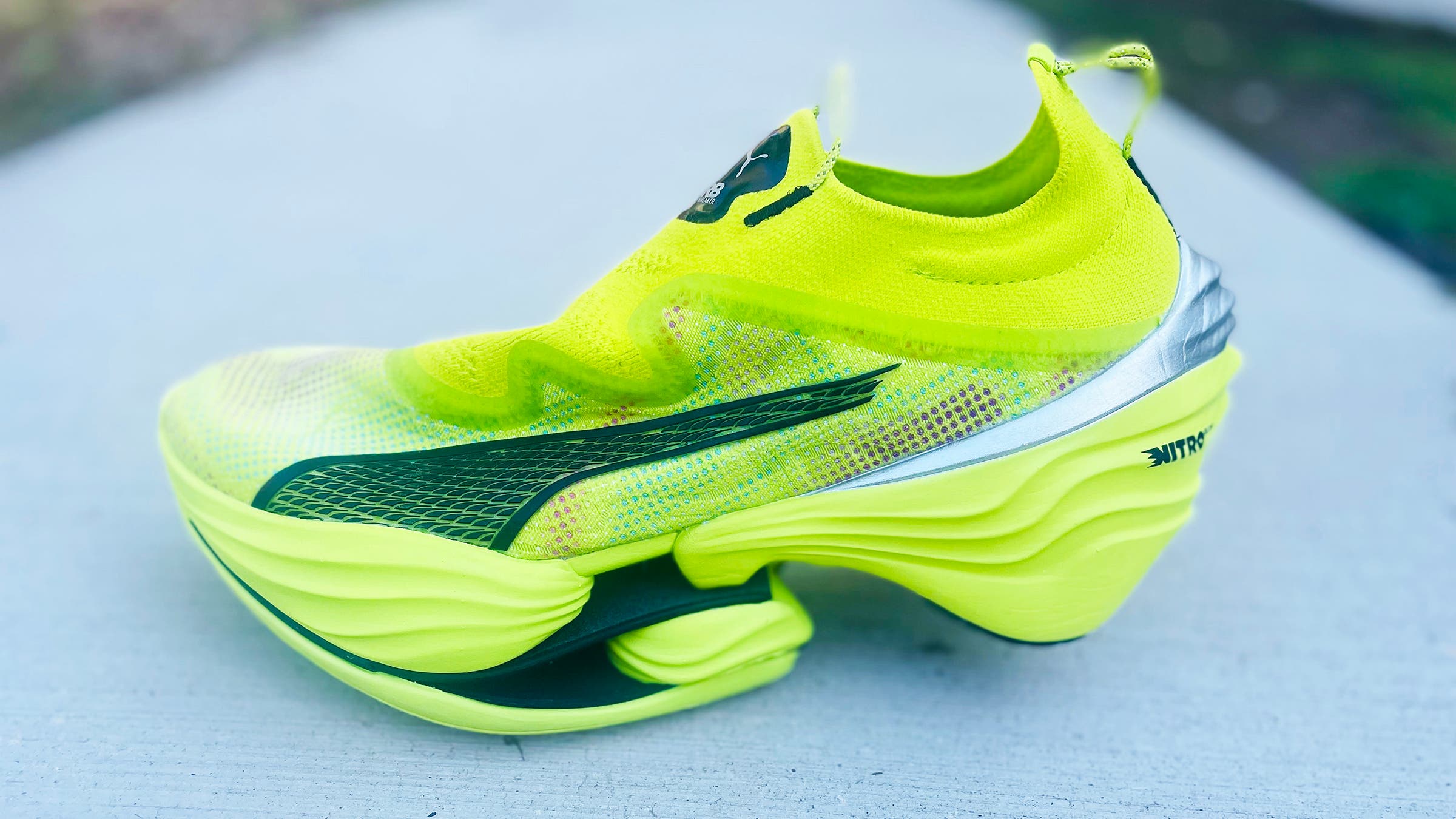
The Method to the Madness
During an interview at Puma’s Nitro Lab at the 2025 Tokyo World Athletics Championships, Romain Girard, Puma’s VP of Innovation, said the brand’s creative mindset is woven into its DNA. He encourages engineers to push boundaries past regulations and even into the absurd. This approach, he explained, is central to Puma’s success in Formula One and directly influences its footwear innovation. Girard noted that the strict regulations governing Formula One cars and those imposed by World Athletics compel engineers to first explore beyond the rules, then use those insights to refine designs that fit within them.
“Puma has always been able to be bolder, to some extent. Less scared of something bigger, compared to others,” Girard said. That mindset has paid off. The Fast-R NITRO Elite 3 was born from lessons learned while developing that eccentric-looking Fast-RB NITRO Elite PR. “Pushing the boundaries of product architecture with the Fast-RB NITRO Elite PR grew our understanding of product behaviors, especially on the plate layering, plate geometry, and Nitro sculpting,” Girard explained.
The same bold, no-limits philosophy informed the design of the five extreme prototypes (four shoes and one track spike) Puma revealed in the Future of Fast showcase at the Tokyo Championships. Girard calls them “concept cars,” and explains that their purpose is solely to learn. “We purposely push the boundaries too far,” he says.
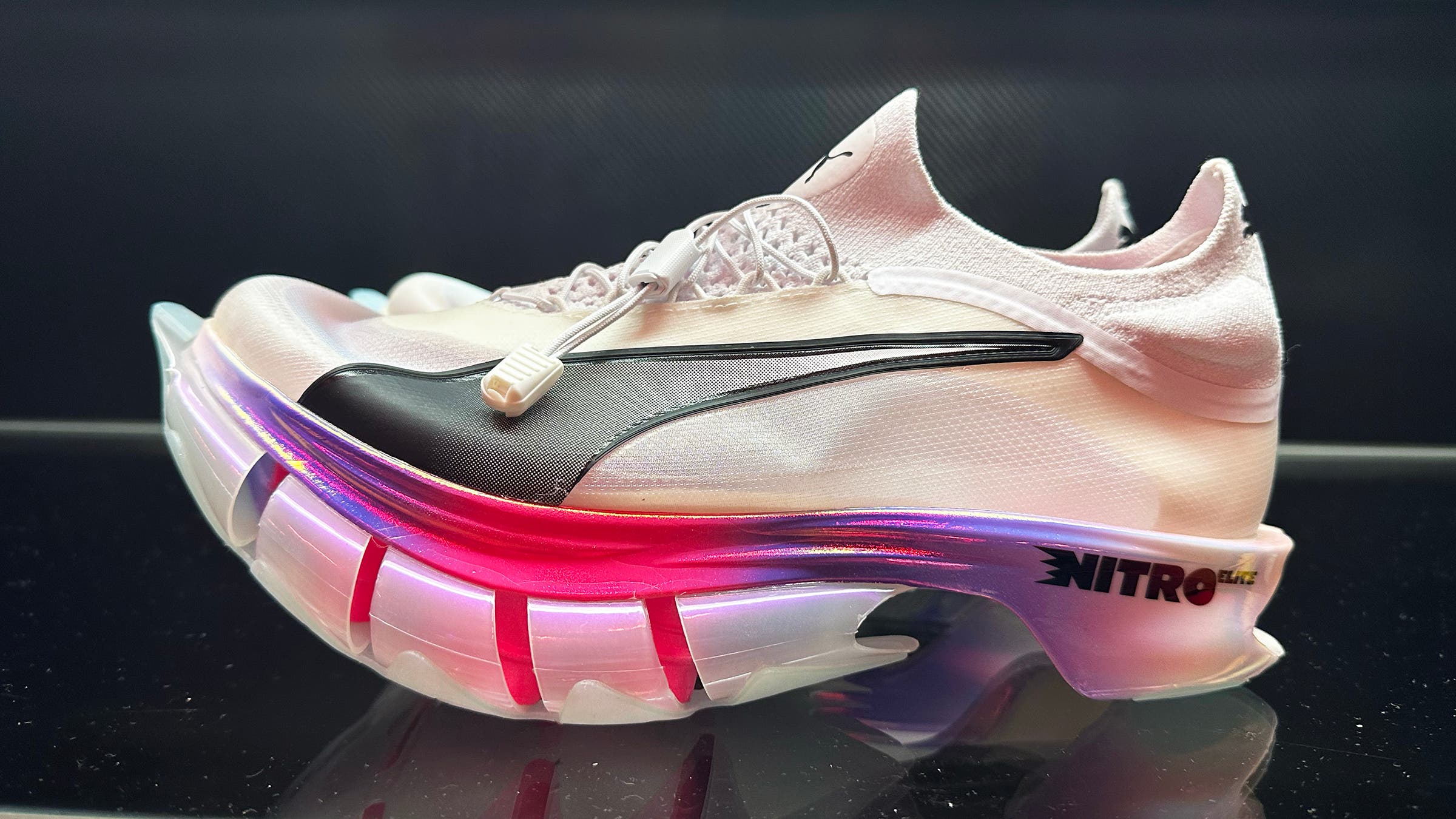
Branded as Fast-XP, short for Fast Experience, these models push shoe design beyond legal limits, into what many considered laughable extremes. Like the Fast-RB NITRO Elite PR, the public debut of the Fast-XP line sparked both curiosity and skepticism, with many questioning whether Puma could be taken seriously. Yet behind the extreme aesthetics lies a calculated strategy: each Fast-XP model is engineered to isolate, amplify, and test a single performance variable.
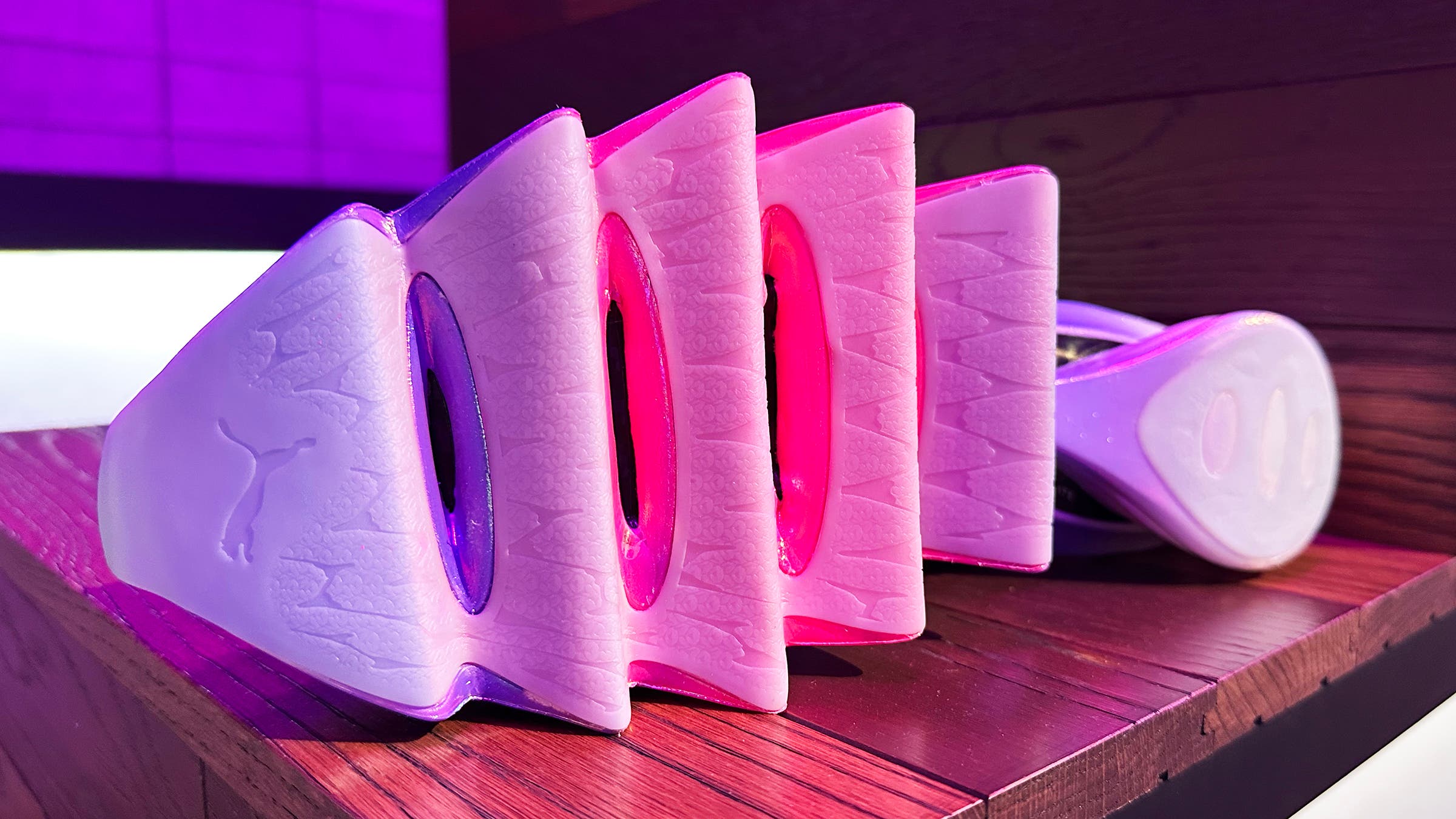
One of the most outrageous-looking shoes ever made, the Fast-XP PLS features a zigzagged midsole and outsole resembling crampon spikes. Girard explains, “The main aspect that we looked at is how we move and how we improve the full benefit from just being a vertical tool to a horizontal tool.” When running, the force on the shoe is directed downward, and the midsole typically absorbs that energy and returns it upward. “The Fast-XP PLS is not playing only with deformation vertically, we are also playing with shearing [forces acting in opposite directions]. The whole idea is to have the shapes of the midsole deforming horizontally and then help them transfer the energy that is coming vertically to help the runner move forward.”
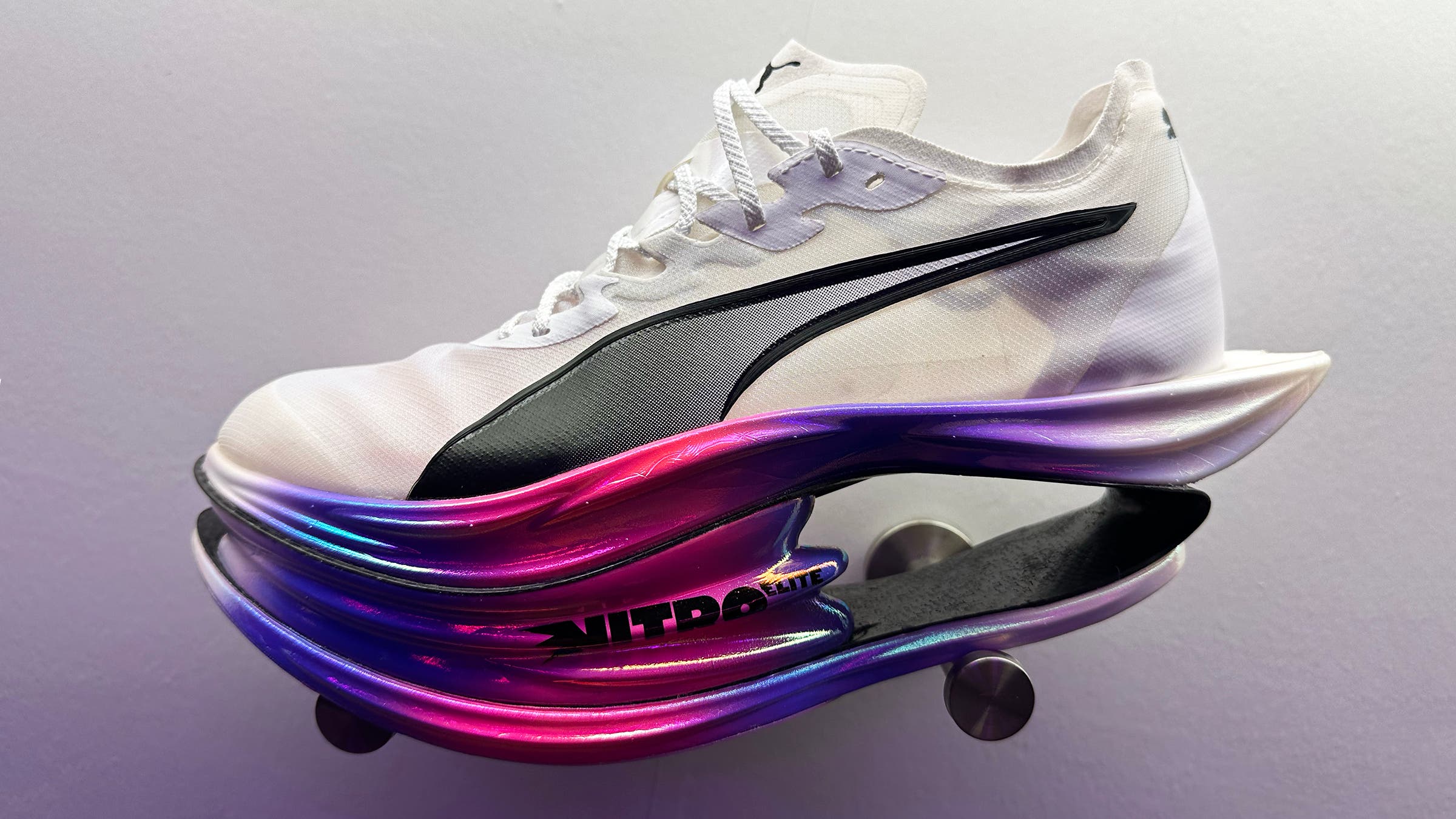
Another example is the Fast-XP BLD. Puma drew inspiration from Para athletes who, despite using prosthetic blades, perform at an exceptionally high level. Building on the same principles and mechanics, Girard’s team focused on plate dynamics and how they interact with Puma’s midsole foam. The design uses two separate, free-floating foam pieces, positioned laterally and medially within the midsole. They found that the placement of foam between plate layers was crucial, not only for transferring energy forward but also for maintaining stability and guidance.
Puma acknowledges that models like the Fast-XP PLS, Fast-XP BLD, and other experimental XP designs will likely never reach the commercial market. However, they emphasize the critical role these prototypes play in their development process. As Girard explains, “These are not an art exposition. This is not a vision. It’s more than that. It is the way we work, and [we] want people to see that.”
When Nike was designing the Vaporfly 4%, it took bold, out-of-the-box thinking, unlike anything else at the time, to bring that shoe to life—and it was wildly successful. Now, with World Athletics defining strict limits on what qualifies as legal for competition, finding meaningful gains within those constraints has become harder. The brands willing to think creatively and, in some cases, unconventionally, are the ones that will keep pushing the boundaries of performance.
Whether these prototypes ever reach runners’ feet is beside the point. In an era of strict rules, Puma isn’t afraid to push well beyond the boundaries, into the absurd, to reveal learnings that can be applied within the legal constraints. With recent breakthroughs like pioneering the next-generation super foam and creating arguably the fastest super shoe ever made, it’s clear Puma’s methods are working, and its trajectory is one worth watching closely.
