
No products in the cart.
Outdoor Adventure
The Best Trekking Poles of 2025

01
Jul
Jul
We’ve been putting the best hiking poles to the test for nearly a decade and have narrowed down to poles that are comfortable, light, durable, and packable. Our top choices have supported us on hikes around the world.
Factors like strength-to-weight, packability, seasonal application, and grip style combine to create unique offerings for the ever-evolving specializations in the outdoors. From day hikes in the mountains of Colorado to trips across Europe, we’ve put these poles through the wringer.
From premium options like the LEKI Black Series FX Carbon to thrifty-hiker-approved Trekology Trek-Z 2.0, we’ve broken this list into categories to help you find the best trekking poles for the adventures you’re embarking on in 2025.
Editor’s Note: We updated our Trekking Pole guide on June 30, 2025 to add the MSR DynaLock Ascent Carbon Backcountry Poles. These carbon poles are some of the best collapsible sticks we’ve used so far, and do so without sacrificing strength.
The Best Trekking Poles of 2025
Best Overall Trekking Poles
9.2/10 Rating
Best Budget Trekking Poles
6.7/10 Rating
Best Balance of Performance and Price Trekking Poles
7.4/10 Rating
Best Thru-Hiking Trekking Poles
8.6/10 Rating
Best Trail Running Poles
7.9/10 Rating
Best 4-Season Trekking Pole
8.5/10 Rating
Best Collapsible Trekking Pole
8.2/10 Rating
Best Overall Trekking Poles
Pretty lightweight at just over 1 pound per pair
Durable lever locking system
Ergonomic cork grip with an extension for sidehilling
Easy-to-adjust length
Quite pricey compared to other trekking poles
Lever on locks is a glass-filled polymer, not metal
Best Budget Trekking Poles
Affordable pricing
Comfortable foam grips
Foldable and compact when stored
Comes with many different baskets and tips covers
Lever locks are metal
Heavier than most
Foam grip can be a little sweatier than cork
Best Balance of Performance and Price Trekking Poles
Cozy cork grips with Bloom foam extensions
Sleek, confidence-inspiring locking system
Durable but lightweight
1.5 mm hex bit tool built into pole shaft for quick maintenance
Left flick locks are on inside of pole and sometimes catch
Packed length is a bit long
Best Thru-Hiking Trekking Poles
Lightweight at less than 10 ounces per pair
Carbon fiber shafts are super durable
Twist lock mechanism only requires setting length on one section
Quite packable
Long enough to be used with trekking pole shelters
Pretty minimal strap design, can loosen while running
Twist-lock mechanism requires some maintenance to keep working
Best Trail Running Poles
Ultralight at only 9.8 oz. per pair
Rapid deployment with easy-to-use push button lock
Compact storage down to 13″ packed length
Comfortable EVA foam grip
Fixed length isn’t adjustable
Wrist straps can’t be stripped
Best 4-Season Trekking Pole
Large diameter aluminum shafts are tough
Extended foam grips for steep side hilling
Wrist straps can be easily stripped
Hook on pole ends can be used for flipping risers on snowshoes or skis
Important to break down and store poles dry, as aluminum oxide can build up
Flick locks are fairly basic with plastic bails
Doesn’t pack down very short
Best Collapsible Trekking Pole
Impressively short collapsed length
Rugged Kevlar-reinforced carbon shafts
Tool-free clamp adjustment
Extended EVA foam grip for sidehilling
Carbide tips aren’t replaceable
Trekking and snow baskets are tough to get on
Other Trekking Poles to Get Down the Trail With
The seven trekking poles above are our favorites for pretty much anything we like to do outdoors, whether that’s a quick day hike or rucking deep into the backcountry. That said, we’ve tested plenty of other winners in our day, and you should consider the alternates below before deciding which pole is right for you.
Quick-deploying mechanism is simple and smooth
Compact packed length
Solid lever lock system doesn’t budge
Extended grips work well on off-camber trails
Not quite as light as the Black Series FX Carbon poles
EVA foam grips are nicer for colder hikes, as they can hold sweat
Still pricey
Tough carbon build
4-season ready build will accommodate 100 mm powder baskets
FlickLock Pro adjusters are excellent metal design
Comfortable straps
On the pricier side
Not as light as a full carbon pole can be
Packed length is up there
Great trekking poles for the moderate price
Lifetime guarantee against shaft breakage
Nicer cork grip than most poles at this price point
Wrist straps stay put all day
Packed length is pretty long
No extended grip for awkward sidehills
We wished for additional baskets for varied trail conditions
Impressively lightweight (without feeling flimsy)
Flick lock adjustability in an ultralight pole design
Comes with a Dyneema Composite Fabric stuff sack
Friction-fit pole connection is tightly machined
Long enough to pitch many trekking pole shelter
Lack of wrist straps will be a no-go for some, but they are now available
Specialized Komperdell baskets are a bit tough to find
Comfortable cork grip
Simple, effective locking mechanism
Ergonomic grip shape with 8 degree forward angle
LEKI straps are among the nicest to use
Comparatively long collapsed length
Not immune from vibrations while hiking
Budget price
Lever lock adjusters are tool-free
Lifetime warranty on aluminum pole shafts
Cork grips on a budget pole
Grips aren’t quite as forward-leaning as other LEKI poles
Better value poles out there
Packed length is long
Super cheap
Well-made design for the price
Comes with plenty of different baskets and feet
Cork grip in a budget pole
Not super durable
Quite heavy
Durable but not overly heavy
Carbon shafts dampens shock well
Large lever locks are easy to close
Lightweight trekking basket keeps swing weight down
Large collapsed size
Locking mechanisms sometimes loosen
Foam grips deteriorate quicker than some
Trekking Poles Comparison Chart
| Trekking Pole | Price | Measured Weight (Pair) | Packed Size | Usable Length (CM) | Material |
|---|---|---|---|---|---|
| LEKI Black Series FX Carbon | $269 | 1 lb., 0.1 oz. | 16″ | 110-130 cm | Carbon |
| Trekology Trek-Z 2.0 | $44 | 1 lb., 8 oz. | 15″ | 100-120 cm; 115-135 cm | Aluminum |
| Black Diamond Pursuit | $170 | 1 lb., 0.4 oz. | 22.7″ | 58-125 cm; 63-140 cm | 7000-series aluminum |
| Gossamer Gear LT5 | $195 | 9.8 oz. | 23.5″ | 60-130 cm | Carbon |
| Black Diamond Distance Carbon Z | $200 | 9.8 oz. | 13-17″ | 110; 115; 120; 125; 130 cm | Carbon |
| Black Diamond Expedition 3 | $135 | 1 lb., 3 oz. | 22.2-24.2″ | 85-125 cm; 100-140 cm | Aluminum |
| MSR DynaLock Ascent Carbon Backcountry | $190 | 1 lb., 1 oz. | 14.25″ | 100-120 cm; 120-140 cm | Carbon and Kevlar |
| LEKI Makalu FX Carbon | $230 | 1 lb., 2.3 oz. | 16″ | 110-130 cm | Carbon |
| Black Diamond Alpine Carbon Cork | $200 | 1 lb., 1 oz. | 24″ | 61-130 cm | Carbon |
| LEKI Khumbu Lite | $120 | 1 lb., 1.2 oz. | 26″ | 100-135 cm | Aluminum |
| Durston Iceline Trekking Poles | $169 | 9.7 oz. | 19.5″ | 94-127 cm | Carbon |
| LEKI Makalu Lite | $150 | 1 lb., 1.6 oz. | 26.3″ | 100-135 cm | Aluminum |
| LEKI Legacy Lite | $100 | 11 oz. | 26″ | 100-135 cm | Aluminum |
| Cascade Mountain Tech | $30 | 1 lb., 4.8 oz. | 26″ | 66-137 cm | Aluminum |
| REI Co-op Flash Carbon | $169 | 13.6 oz. | 27″ | 105-140 cm | Carbon |

How We Tested the Best Trekking Poles
We pride ourselves on a testing process that exposes flaws and highlights strengths while observing a range of equipment options. Good gear should last a long time, and to do that, it needs to exhibit durability. When evaluating the best trekking poles, we test the features that commonly break down, including the locking mechanisms, grips, and straps, to ensure that only the most reliable poles make it on our list.
Our Testing Process and Testing Grounds
We field-tested these poles in a wide range of environments and weather over different types of terrain. As avid users, we know the features that can elevate one pole above the rest. To find the best, we analyzed what makes each pole unique and tested them in unique environments doing the activities these poles are more likely to be used in.
We’ve been pretty far and wide doing it, too. The testing team has collectively crossed the United States in a north-to-south fashion at least six times, and we’ve taken some further afield trips as well. From weeks-long traverses in Iceland to nosing into the Himalayas, having stable footing and easing our knees was a constant requirement.
Finally, once we’ve formed an opinion, we cycle these poles out to different members of the testing team so that our coverage is well-balanced.

Weight from pole to pole typically doesn’t vary much, but it’s surprising how a few ounces can build up over an entire day. That’s why we weigh each pole in-house to verify it for ourselves. We also break out the ruler for collapsed and extended lengths, and even the micrometer to measure pole thickness.
The ease at which each of these poles could be serviced at home was also tested, and we compared notes on tightening or cleaning different adjusters, as well as putting on new baskets or replacing carbide tips.
Our Expert Testers
Chris Carter, one of the lead authors of this guide, has thru-hiked the Triple Crown of long trails in the United States: the Pacific Crest Trail, the Continental Divide Trail, and the Appalachian Trail. He knows the value of a reliable trekking pole for absorbing impact on the body, helping with stability over tricky terrain, and pitching a shelter at night. He’s pretty particular about the poles he depends on in the backcountry.
Jackson Sims-Myers and Samuel Martin also both contribute to the testing team, and are both thru-hikers as well. That brings the trail mile cred for this guide to well north of 20,000 and climbing. Sims-Myers is a multi-sport guide located in southern Utah, while Martin is a commercial photographer who covers the Eastern Seaboard from Charlotte, North Carolina. Both have bent a trekking pole or two in their days.
Buyer’s Guide: How to Choose a Trekking Pole

Weight & Packed Size
The packed-down length isn’t of vital importance to most hikers and backpackers. But, for those who plan to travel with their poles, it’s best to look for a pole that packs down small enough to fit in your luggage.
The LEKI Black Series FX is a perfect example of extreme packability. Its collapsible z-pole design separates the segments completely, allowing it to pack down to a mere 16 inches, easily fitting into most daypacks alongside other supplies.
For weight, you can’t beat the Gossamer Gear LT5. At 4.9 ounces each, you’ll hardly notice these sleek poles, and you can keep them handy for just-in-case scenarios.
And while some poles will only collapse into themselves, others, like the Trekology Trek-Z 2.0, have independent segments that fold up when collapsed, making them smaller than most collapsible poles. These poles do use more section joints than other poles, which should be a consideration for long-term use. In our testing, however, we’ve yet to see fold-up poles expire prematurely.

Pole Length
Pole length is one of the most significant factors for a good trekking pole fit. To estimate the ideal length, stand up straight (preferably wearing the hiking shoes you’ll hike in) and bend your arm to a 90-degree angle. Measure from the floor to your elbow to calculate your length.
In general, people 5’1″ and under will choose a 100 cm pole. Those from 5’1″ up to 5’7″ will use a 110 cm pole. Hikers ranging from 5’8″ to 5’11” will need a 120 cm pole. And those taller than 6′ will go with the 130 cm option.
A pole with a wide range of adjustability will work for almost everyone. Once you’ve measured your size, you can explore fixed-length options.

Fixed Length vs. Adjustable
There are viable reasons to consider each option. Adjustable poles will allow you to quickly change their length to fine-tune them on the trail to your personalized needs. If you’re exhausted, you can adjust them to transfer more weight to your upper body.
Adjustable poles allow you to extend or retract steep ascents or descents. The downside is an increased possibility of failure or slippage at the locking points, especially with twist locks.
Fixed-length poles offer less fine-tuning but can handle more weight. Generally, fixed-length poles are ideal for trail running and other fast-paced endeavors where adjustments will only slow you down.
Some fixed-length poles, like the trail-running-specific Black Diamond Distance Carbon Poles, don’t fold up. Others are a fixed length when deployed but break down for packing.

Women’s-Specific Trekking Poles
Generally, women’s-specific trekking poles have a smaller grip diameter (which offers increased comfort for smaller hands) and a shorter maximum length.
Another bonus of women’s-specific trekking poles is that the minimum length is shorter, which increases packability. Due to their smaller size, the women’s options also shed a bit of weight.
In reality, it’s less about the gender of the given user and more about the size. Anyone looking for a smaller grip and a shorter pole should consider buying a women’s-specific trekking pole.

Grips
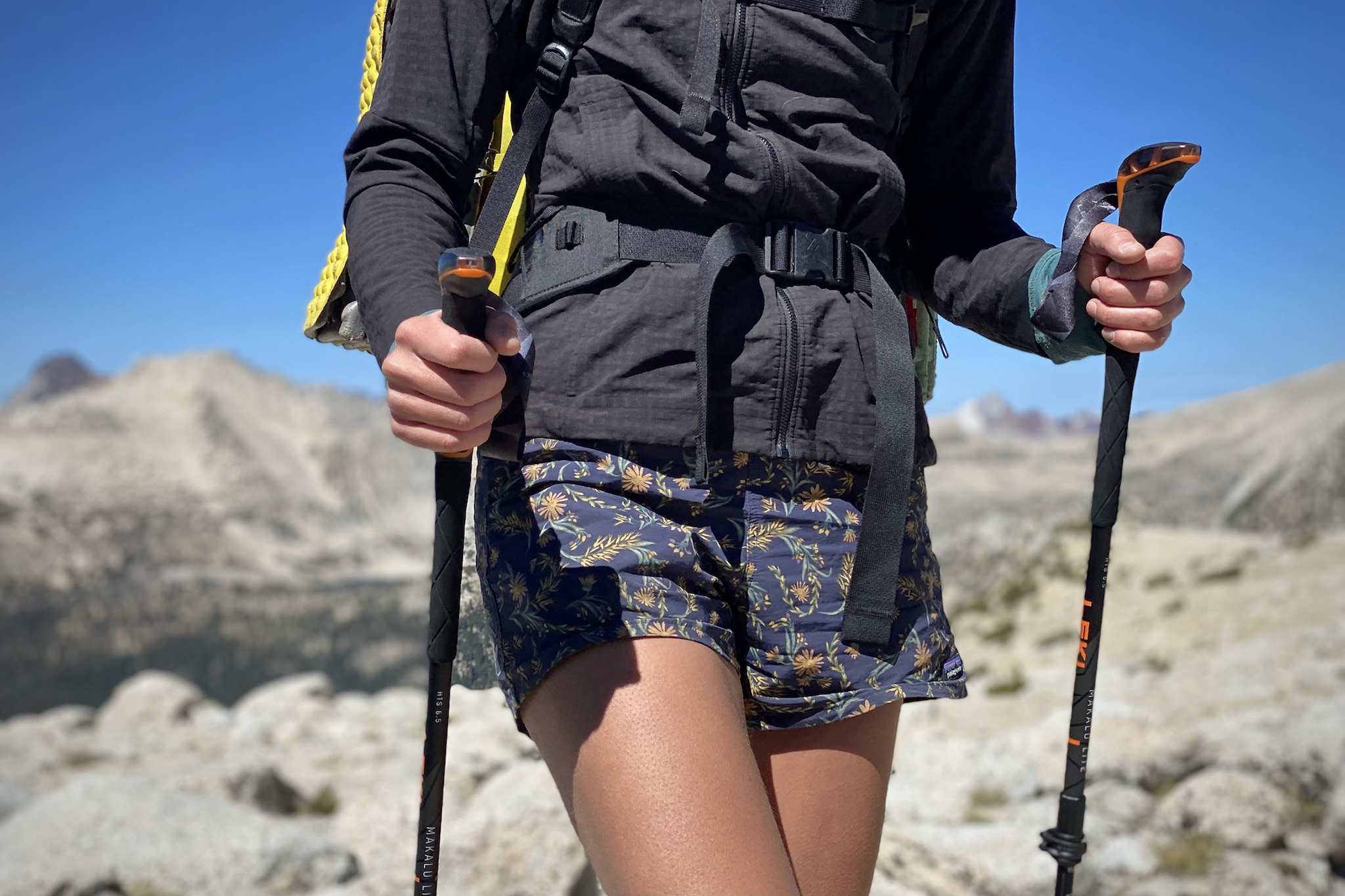
Trekking pole grips come in three primary materials: cork, foam, and rubber. Ideal grips will wick moisture well, be comfortable on your skin, and work as shock absorbers. Cork and foam are the most common materials used for trekking pole grips, and for most, the preference simply comes down to feeling.
- Cork is exceptionally light, wicks moisture well, and is also very environmentally friendly. Cork grips are the best at absorbing shock, and also form to your hand over time. The Black Diamond Alpine Carbon Cork offers an ergonomic cork grip.
- Foam grips are also very light, but rather than wicking moisture, they tend to absorb it. The tradeoff would be for grip, as EVA foam is quite tacky. Higher-quality foam, like on the LEKI Makalu Lite, performs well across all categories. Between foam and cork, the weight difference is negligible.
- Rubber grips are rarely used in modern trekking poles, and tend to be utilized strictly for snowsports.
Tips
Most manufacturers of trekking poles offer the industry standard: carbide tips. They’re incredibly durable and offer grip and pinpoint precision over various terrain, performing equally as well over rock, ice, and softer, variable surfaces.
However, carbide tips can inflict some damage on the environment, so some prefer rubber tips when traversing delicate landscapes. They can also be noisy over rocky terrain. Gossamer Gear includes some very handy rubber boots with their ultralight LT5 poles, which are easy to place and remove.
Any tip will wear down after prolonged use and should be replaced when the metal wears up to or near the plastic.
Rubber tip protectors come with or are available for most trekking poles. They’re not only useful if you find yourself on shelves of rock or pavement, but can extend the life of your tips in storage (and keep them from snagging clothing in your pack).
Baskets
Trekking poles generally come with “mud baskets.” They not only prevent splashing and give support in mud, but can also help when traveling over soft dirt or sand. They are especially beneficial for thru-hikers who will encounter snow on high-elevation passes.
If you’re traveling over snowy terrain without baskets, you’ll find out the snow depth pretty quickly, and unless you can lengthen the poles to match that depth, they’ll be rendered useless.
These days, almost all poles available come with standard-size mud baskets, and many even come with some extra powder baskets for all-season use. If you want to utilize your poles for winter sports, check to see if they come with powder baskets, and be sure to check compatibility if you order them from a third-party manufacturer.
Do You Need Trekking Poles?

Advantages of Trekking Poles
- Distribute some of the work and weight distribution to your upper body. Although using your arms can increase your overall energy use (see cons below), trekking poles are an effective and valuable leg-saver, especially on longer or more strenuous outings.
- Save your knees and joints on descents. Studies show that using poles significantly reduces the impact on your knees while hiking downhill. When more weight gets factored into the equation, trekking poles can be essential for long-term health.
- Improve your balance on uneven terrain. That’s especially true over river crossings where slippery rocks can ruin your day.
- Help you maintain a consistent gait. Trekking poles can lead to a faster, more efficient pace.
- Add a multipurpose tool to your kit. Many options can double as ski poles with the addition of powder baskets. Many ultralight backpacking tents require trekking poles as structural support to save weight. Poles can also help set up shad structures in areas lacking coverage on sweltering days.
Cons of Trekking Poles
- Your overall energy output is increased. While it may seem counterintuitive, we’ve found the benefits of physiological preservation, balance, and safety outweigh the effects of extra output.
- Additional cargo. If you choose not to use your poles, they become another piece of gear to carry or be strapped to your backpacking backpack. This is where packability becomes essential.

How to Properly Use Trekking Poles
If you’re buying trekking poles for the first time, or have simply never thought about the best way to use them, it can be helpful to understand the most efficient way for them to complement your stride.
Length: For setup, you’ll want your arms to be at a 90-degree angle when the tips are weighted on the ground before you. Adjustable poles offer the benefit of micro-adjustments, whereas fixed poles don’t. This is especially important to consider which pole style you want to purchase. If you are hiking with adjustable poles, it’s a good idea to adjust the length of the poles as you climb or descend a hill, keeping that 90-degree angle as constant as possible.
Wrist straps: The wrist straps should comfortably wrap around your wrists (not so tight that they’re squeezing, but not so loose that they’ll slip off your wrists if dropped). With your hands vertical on the grips, the top of the strap should rest where your wrist hinges if you lift your thumb from that position.

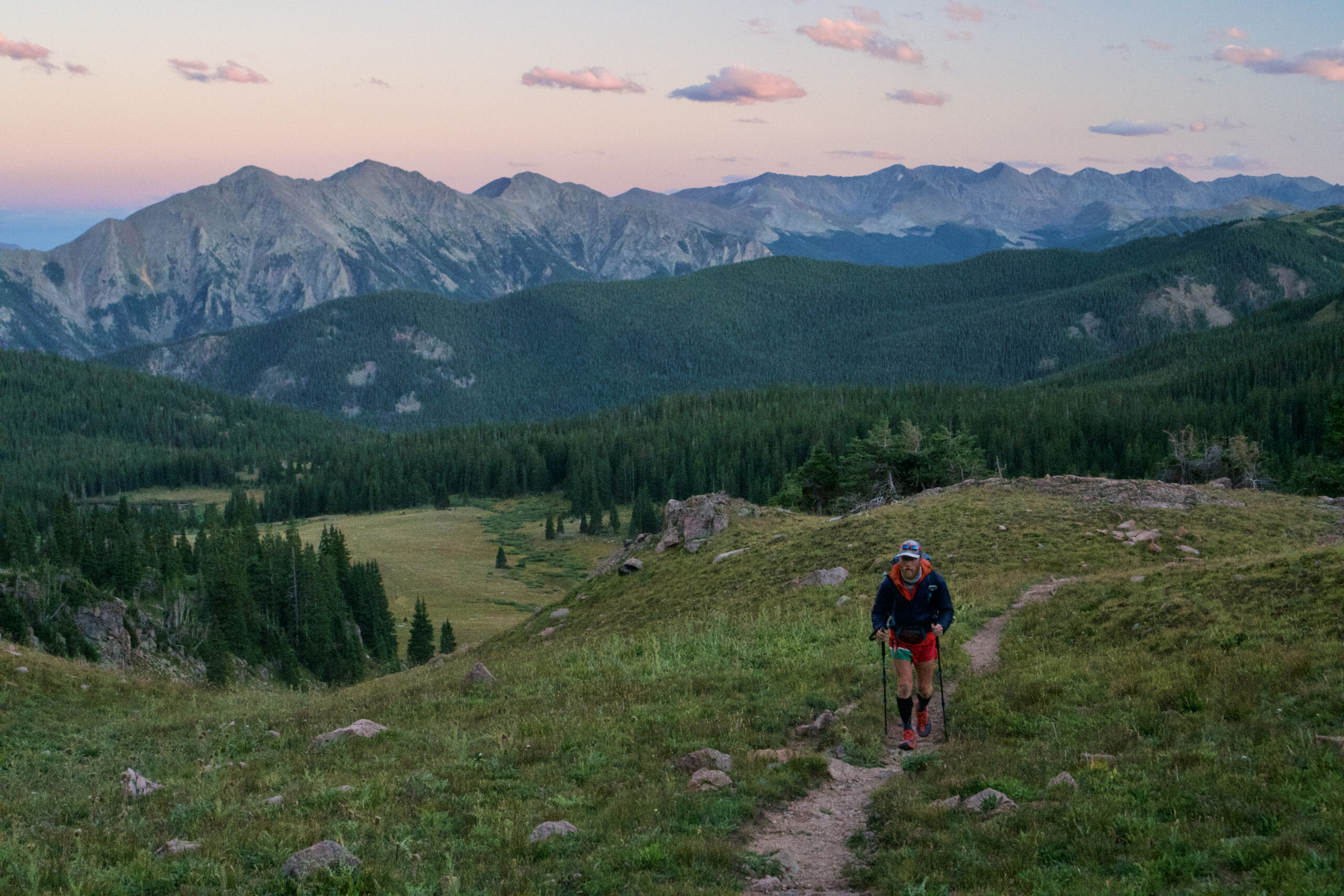
Stride: As an extra set of legs, the most efficient way to use trekking poles is to extend the opposite pole to hit the ground just before your opposite foot (i.e., the left pole should extend as you lift your right foot to step). This allows the pole to absorb some of each step’s impact and takes some of the weight off your legs. On very steep descents, many people prefer moving their hand to the top portion of the grip or increasing the pole’s length and placing both poles at once for balance.
Placement: Placing poles as you walk on mellow terrain is simple (see paragraph above). Over rock or talus, however, it can become a bit more complicated. It’s never good to have the pole wedged in between or just behind a rock as you step, as it may stick in the ground and break/bend under the force. Otherwise, you want to place them in a secure position that helps keep you balanced.
On the trail, it’s common to see a wide range of trekking pole techniques. Some people sling them along and place them in random increments, whereas others really lean into the poles and transfer weight with each step.
While there are various ways to have them bear weight when moving through technical terrain, the above technique (alternating opposite pole from leg) has proven to be the simplest, most efficient technique for walking along flat, moderate, and steady uphill terrain.

Price & Value
Trekking poles are well worth what you might pay for them, but that being said, there is a certain price you’ll pay for access to nicer options. Typically, this will mean trading dollars for features and comfort, but also in dropping weight. Consider how often you’ll be using your trekking poles, as well as where you’ll be going. The needs of an ultra runner are certainly different than a day hiker.
Budget
Balancing quality and price can ensure the average user gets the trekking poles they need without breaking the bank. Aluminum is the standard here, along with two—or three-piece designs that collapse down. You typically won’t see the most adjustable lengths here, but so long as they fit you, you should be fine.
Typically running from between $30 and $80, budget options like the Trekology Trek-Z 2.0 ($44) balance needs well, and are even a z-pole design that compresses down small enough to fit in your pack. The slightly higher weight of 8 ounces north of a pound is common, and while these poles are heavy, there are lighter options.
Mid-Tier
From $100 to $150 is where you’ll get a lot more for your money, and we generally believe that most folks are best served at the upper end of this range. Under $150 is the cutoff for carbon fiber poles (with the Durston Icelines representing the bottom dollar — a great value at $169), and you’ll also get more breathable cork handles and smaller collapsed lengths.
The Black Diamond Pursuits are a great value for the price, and while they are still aluminum, they weigh less than the LEKI Makalu Lite. The adjustment mechanism is one of the only moving parts on a trekking pole, and it’s worth investing in smooth-operating examples with lever locks. The alternative here is twist locks, which aren’t as solid in our experience.
Premium
Paying north of $150 ought to have a good reason, and these poles are most often specialized carbon fiber jobs that are either wickedly light or sport all the best features. These include all-aluminum adjusters like the FlickLock Pros on the Black Diamond Alpine Carbon Corks that just work perfectly, or collapsible systems that allow the LEKI Black Series FX Carbon poles to pack down to 16″.
The race to the bottom is also where the big bucks are, and our favorite UL hiking pole (Gossamer Gear LT5) and ultra-running pole (Black Diamond Distance Carbon Z) are both $190 or more, but are also less than 5 ounces per pole. Over a thousand miles or two, weight adds up.

Frequently Asked Questions
Trekking poles aren’t required, but they can certainly be helpful! For long treks with a heavy pack, they help distribute your weight and decrease the impact on descents. They’re also great for stabilization on rocky treks, hiking along an exposed trail, or when river crossings might get a bit techy.
You could use a single pole or a hiking staff, but, in general, we recommend a pair of hiking poles. They provide a more balanced, ergonomic gait and increased stability.
Packable options allow you to stow a pole away when both don’t seem necessary, or if you need one hand free for snapping photos.
The trekking pole grip should rest comfortably in your palm when your arms are bent at a 90-degree angle.
In general, people 5’1″ and under will choose a 100cm pole. Those up to 5’7″ will use a 110-115cm pole. Hikers ranging from 5’8″ to 5’11” need a 120cm pole. And those taller than 6′ will go with the 130cm option.

The short answer is yes, but it depends. Some hikers prefer to use them all the time; others rarely use them and might even remove them from the pole entirely to cut additional weight, especially if they tend to hike on easy-going trails.
The use of straps comes down to personal preference, but there are some real benefits to utilizing this feature. Straps increase stability and allow more power transfer into the poles on steeper gradients. It’s also much harder to drop your poles off the side of a mountain or exposed terrain if they are attached to your body.
Telescoping poles offer a more extensive range of usable lengths than all the others. While they take a little longer to set up than folding poles, these poles are more durable and customizable to the terrain you’re hiking or running on.
Folding poles are often lighter and much more compact in their collapsed position; however, they have a significantly smaller range of adjustability. But for runners and fast-packers, their quick setup or breakdown on the move is unmatched.

Some companies offer a combination of the styles, like our best overall trekking pole of 2025. These poles combine aspects from both styles, blending the speedy setup, compact storage, and some adjustability — the primary compromise is the smaller range of adjustment this design type offers.
Fixed poles are not collapsible, but they are the lightest out there. When deciding to purchase a pair, you’ll need to make sure you find the size that works for you. Check out our Comparison Chart for a breakdown of the specific size ranges, price points, and weight per pair for our favorite poles of the year.

If you’re looking for the best hiking boots, look no further. We’ve tested dozens of hiking boots over hundreds of miles to help you stay happy and comfortable on the trail.

Whether you’re looking to spend 100 nights on the trail or stick to a tight budget, we’ve found the best backpacking tents of 2025.
