
No products in the cart.
Fitness Tips
Maps Show U.S. States Facing Most Snow This Winter: How Reliable Are They?

20
Sep
Sep
The Farmer’s Almanac and Old Farmer’s Almanac, which are different publications, predict winter weather and snowfall forecasts. But how reliable are they?
Both publications have been heavily cited by news outlets because they publish maps predicting things like winter snowfall months ahead of time. You can see the winter prediction maps for the Old Farmer’s Almanac and Farmers’ Almanac below. They both reveal some details about their methodology, but they keep some of it secret.
The Farmers’ Almanac says it has been making predictions for 200 years. Some scientists dispute the techniques, but the almanacs stand by them and say they have good track records.
One expert isn’t so sure. J. Marshall Shepherd, a University of Georgia atmospheric scientist, told USA Today: “Scientific-based weather forecasting and short-term seasonal prediction has advanced significantly. Our models, observational systems and knowledge base has made short-term prediction, hurricane tracking, and El Niño forecasts quite reliable.” He added: “Yet people still default to groundhogs, almanacs and folklore.”
The Old Farmer’s Almanac Forecast & Winter Map
Winter 2026-27 prediction courtesy Old Farmer’s Almanac. pic.twitter.com/Pg3QQnxMIP
— Jim Smith (@Jimanji_Smith) September 16, 2026
You can find maps predicting long range forecasts, including for winter, by state.
How does the Old Farmer’s Almanac determine its forecasts and maps? “On average, we correctly predict the direction of seasonal temperature and precipitation departures about 80% of the time,” the site explains. The site was slightly more accurate at predicting precipitation than temperature.
“The Old Farmer’s Almanac predicts weather trends and events by comparing solar patterns and historical weather conditions with current solar activity,” the site noted, adding that this differs from the methodology used by traditional meteorologists.
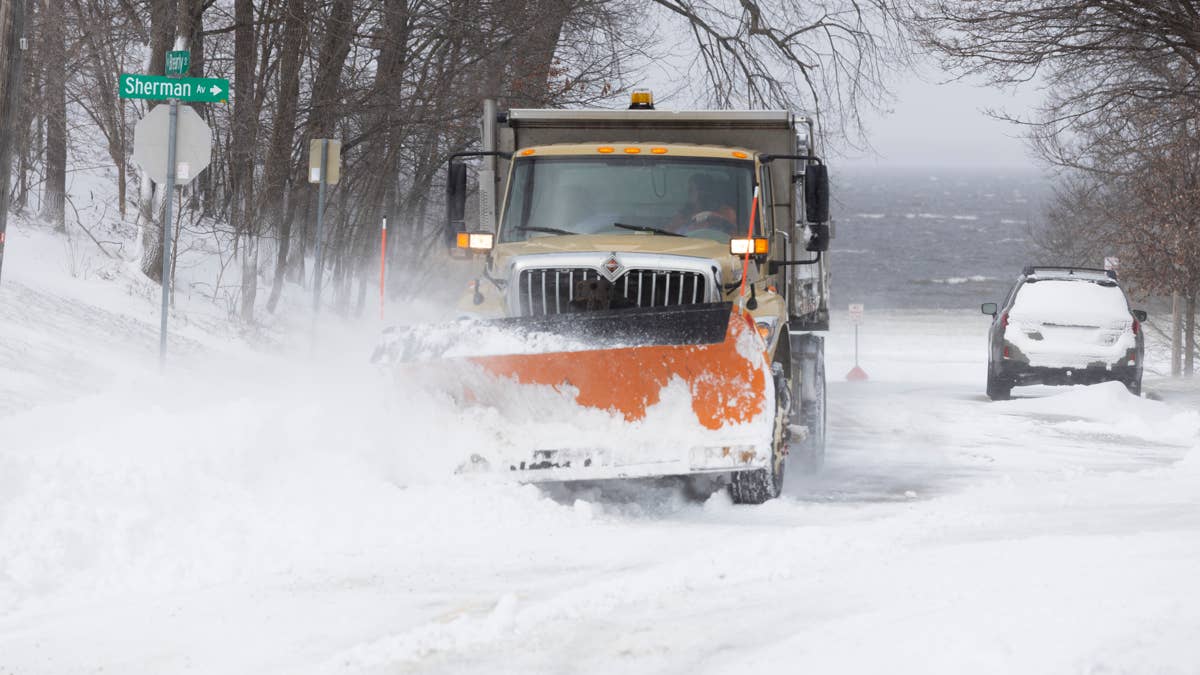
(Photo by Joe Timmerman/Wisconsin Watch via Getty Images)
“Our extended winter weather forecasts emphasize temperature and precipitation deviations from averages, or normals. These are based on 30-year statistical averages prepared by government meteorological agencies.”
The technique dates back to the almanac’s founder and uses sunspots: “We derive our weather forecasts from a secret formula that was devised by the founder of this almanac, Robert B. Thomas, in 1792. Thomas believed that the weather on Earth was influenced by sunspots, which are magnetic storms on the surface of the Sun.”
What About the Farmers’ Almanac?
❄️ SNOW FANS: Here’s the average time frame for the first snowfall of the season across the United States! Map via the Farmers’ Almanac. pic.twitter.com/9dzDnaosWt
— Mark Tarello (@mark_tarello) September 16, 2026
The Farmers’ Almanac also considers sunspots.
“Over the years, various methods have been used to make the Farmers’ Almanac predictions, including studying sunspot cycles, solar activity, tidal forces, and even the reversal of winds in the stratosphere over the equator,” that site explains.
“One essential factor that we consider in our extended weather forecasts is the influence of our celestial companion, the Moon. As students of meteorology know, the Sun’s rays warm Earth’s atmosphere, leading to the exchange of heat and vapor between the surface and the air,” it adds.
According to the Farmers’ Almanac, the formula is kept secret but it relies on “sunspot activity, tidal action of the Moon, the position of the planets.”
The Almanac’s forecasts are predicted two years in advance.
